Death of a pig, (part 9) Head Cheese

Nearly 4 months after he was delivered to us Hoosier’s hoof-prints are still making big imprints on our menus.  We are using the leaf fat for the biscuits being serving with fried chicken on our lunch menu.  His jowls, that we cured to make guanciale are being served with a locally produced Buratta cheese.

20170130_221918

Peppered Coppa

On our Charcuterie Chalkboard we are still featuring spiced coppa,  his back fat is in our kielbasa and chicken sausage, and the fat from the hams we smoked are being used to make ham fat – potato croquettes.  The remaining freezer fodder includes some smoked skin and bones, a fair amount of back fat and a few pounds of meat that will end up as sausage, rillettes or even braised.


Beyond all that, I just made a non-traditional head cheese, inspired by the head cheese I had at  Cochon a great restaurant in New Orleans.  A few winters back Colleen and I happened by, walking for miles, as we do every time we visit an unfamiliar city.  I had heard of Cochon and since it was about time for a refreshment break, mid-afternoon, we sat outside in the hot February sun, we ordered up some drinks and one of their house-made charcuterie platters.  All of the charcuterie was good, but the head cheese was memorable. It changed the way I have approached making it ever since.

head cheese

Typical Supermarket Head Cheese

Typically it’s the bits of the head; the tongue, ears, cheeks, skin and fat separated by overly gelatinous substance, resulting in a barely palatable concoction. It’s like eating a salty version of that Jello-canned fruit crap my mother would make for us back in the seventies.


At Cochon it appeared as though they pureed together some of the head fat with some reduced braising liquid from cooking the head and then folded in the other bits before pouring in all into a terrine to be chilled.


I made it like that a few times with great results, it really is so much better than the traditional version.

20170412_151218

EVOO’s Head Cheese

I decided to take it one step further and smoke the head before braising it, wow, head cheese went from barely palatable to really good to I want some now!  The smoked version is by far the best; sweet, smoky, salty and super rich.  We currently have it on our charcuterie chalkboard, as is, sliced on a board.  On EVOO’s dinner menu we have made a croquette out of it, breading and deep frying a thick slice, serving it with last summer’s raspberry jam, pickled green tomatoes, scallion – green peppercorn sour cream and a butter basted egg.


20170413_201353

Head Cheese Croquette

We’ll see if Hoosier offers up any other delicacies worthy of another post. He has had an amazing run on our menu, we greatly appreciate all that he has given us.
It’s Not Spring Yet!

not spring

From 4 days ago.

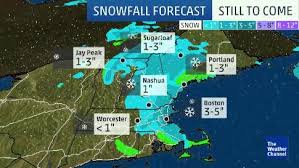
I know the calendar tells us spring has sprung, however, local ingredients are still telling us it’s late winter.  Right now, April 5, locally it’s still all about cellared root vegetables, cabbage and greenhouse greens.

Don’t let those restaurant menus filled with fiddlehead ferns, asparagus, ramps and peas fool you, none of it is local.  With the big snowfall last week and still chilly temperatures, it seems as though spring will be running a bit late this year.  Fiddleheads and ramps are still weeks away, asparagus a month maybe more, and peas closer to two months.   Every year is different and as soon as the real local spring ingredients are available our what-are-we-going-to-make-with-this-root-this-time anxiety is lifted, and the real local spring ingredients are plastered on our menu.

The first signs of spring are happening in our rooftop garden, the chives are about an inch out of the ground.  That’s it, the weeds haven’t even started yet.

making agnolotti

Making Agnolotti

The first food harbinger of spring is usually spring-dug parsnips, this root, wintered in  frozen soil, turning the starches into sugars.  What you end up with is an amazingly sweet full-flavored parsnip.  We received our first batch this week from Hutchin’s Farm, an organic farm located in Concord, MA.  We currently have them on our menu stuffed inside agnolotti pasta, fried chips at we are serving on a beef heart dish, and in a cake as a dessert served with smoked maple ice cream.  They are also roasted or pureed and make a great sweet or savory custard.

20170405_225934

Spring-dug Parsnip Cake with Smoked Maple Ice Cream

The recipe I am including for parsnip cake is really just an adaption of a traditional carrot cake, substituting parsnips for carrots.  I came up with this recipe when a writer from the Boston Globe asked me for an original recipe using parsnips.  At the time I had know idea how this would come out, knowing I just wanted to have a recipe included in her article.  I can’t say I was surprised with the results, they’re great, especially when using super sweet spring-dug parsnips.  As with carrot cake the better the carrot / parsnip tastes the better the cake will be.

Click Parsnip Cake for a link to the recipe.

Sockeye Salmon

Why would a restaurant that prides itself in being part of the community, with a menu where almost every dish is based local sustainable ingredients be using wild Alaskan  Sockeye Salmon?

Well, there are several reasons, first and foremost it is extremely sustainable.  The fisheries are currently very well managed, once the quotas are met the fishing stops, leaving plenty of salmon to swim up the rivers and estuaries to spawn and become bear food.

Bear-eating-Sockeye-1024x683

Secondly is traceability, we are able to verify where and how the fish was caught down to the boat.  Unless you know the fisherman, or are purchasing from a quality fishmonger, you are not able to do that with most east-coast fish.

We purchase our sockeye through Sea to Table a company based in Brooklyn, NY that distributes only wild, domestic, sustainable and traceable seafood.  They’re getting the sockeye from Naknek Family Fisheries a small family-owned business in Bristol Bay, Alaska.  As soon as the fish is caught it’s sorted, keeping the highest quality fish for their fillets.  The fillets are then flash frozen, vacuum sealed and stored until they shipped.  With the salmon run (season) being short and the number of fish caught so large, freezing the fillets for year round delivery is necessary.  Much of the salmon is also smoked and / or canned.

I never thought I would be happy to use frozen fish, I have to admit I was skeptical up until the moment I cooked and tasted it.  The skin crisps beautifully, the flesh is firm and moist.  This fish is a very high quality product; I don’t think it has diminished at all from its fresh state.  I highly recommend everyone eating Bristol Bay Sockeye Salmon.

You may see Atlantic Salmon in stores or on menus, don’t buy it.  It is all farm raised in overcrowded pens, eating more fishmeal than the flesh it is producing and polluting the bays all the while.  There have been great strides made in recent years to make a better-for-the-environment and better tasting farmed salmon though it still pales in comparison to any wild salmon.

Another great thing about sockeye salmon is people love it, it tastes great, with the added bonus that it is also very good for you, high in omega-3 acids, vitamins A, C, D, and E, niacin and Vitamin B-12.  All that and it’s a cinch to cook, very adaptable to many cuisines.

Here some of photos show a few of the ways we have been preparing it.

20150330_130713 (2)

Korean Barbecue Glazed

20151109_121205

In a Banh Mi

20170214_175545

tea-cured hors d’oeuvres

20151109_202235

with pig’s skin risotto and apples

20151207_182520

hot-smoked dip with chips

20151210_121102

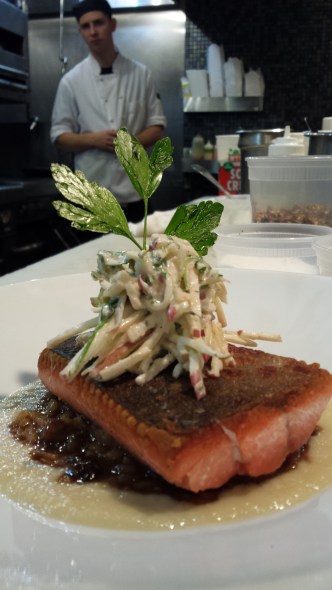
soy glazed with kimchi and mushroom mayonnaise

20170202_182651 (1)

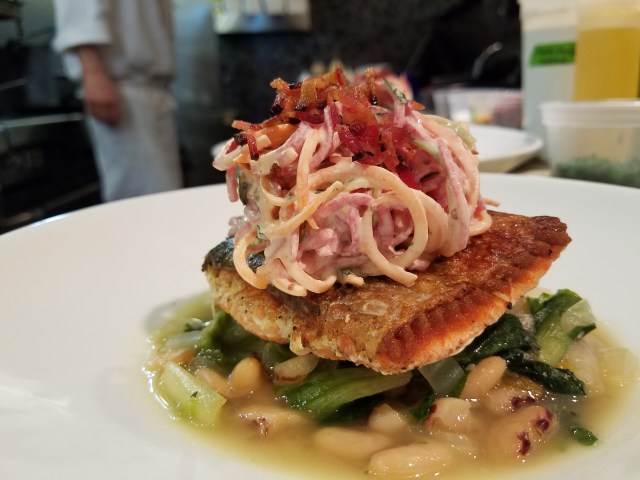
with soldier beans, escarole and bacon


Eat well. Eat wild Alaskan Sockeye Salmon from Bristol Bay.

Valentine, oh Valentine

Just finished another EVOO Valentine’s Day dinner service, our 19th time.  The staff cooked and served some great food.  Thanks to all, YOUR AWESOME!  The only bummer was that our on-line reservation system decided that we were fully booked long before we were even close.  Fortunately Colleen, my Valentine, realized it yesterday, 2/13, so we were able to re-coop some of our reservations.

Here are some photos of our “Here’s the Love Menu”

20170214_185117

“Here’s the Love”

20170214_175537

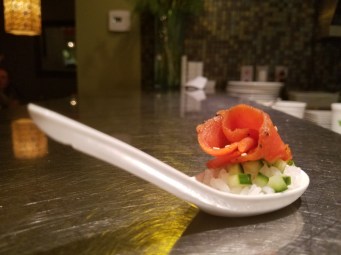
We started everyone off with – Lapsang Souchang Tea Cured Wild Alaskan Sockeye Salmon

Some of our Starters – Foie Gras Custard, Fried Oysters, Carrot Ravioli, Coconut – Sweet Potato Soup and Burratina

Some of the Mains – Beef Rib Eye, Duck and Blue Cod

Chocolate Cake, Walnut Tart and Passion Fruit Pudding Cake

New Menu items

We added a couple of new items to our menu tonight, both will be available for lunch and dinner.

Pasta dish changed to-

Billy’s Spaghetti with Braised Rabbit, Countneck Clams, Chervil, Tarragon, Fennel Cream and Zesty Crunch

20170202_185100

Billy our saute cook made the spaghetti, the rabbit is from Feather Brook Farms in Raynham, MA.  The countneck clams are from Island Creek Oysters in Duxbury, MA


New fish dish-

Seared Wild Alaskan King Salmon Fillet with Soldier Beans, Escarole, Turnips, Carrot – Radish Salad and NH Smokehouse Bacon

20170202_182651

The salmon is caught by the Nicholson family in Bristol Bay, Alaska.  Soldier Beans are from Osbourne Family Farm in Charleston, ME.  The carrots are from Drumlin Farm in Lincoln, MA and the turnips and radishes hail from Verrill Farm in Concord, MA.  The bacon is from North Country Smokehouse in Claremont, NH.

Death of a pig (part 7.5)

Back to the ham, I had a Panini today made with Hoosier’s ham.  It was fantastic, Mark (our day sous chef) did the sweet and smoky ham up with Robinson Farm’s (Hardwick, MA) Family Swiss and dill pickled onions served on Raul’s (our baker) sandwich bread. I enjoyed with some of our homemade fries and Alex’s (our long-time lunch cook) tangy ketchup.

My lunch, fries were added after I took the photo.

20170201_225928

Death of a pig (part 8) Saucisson Sec

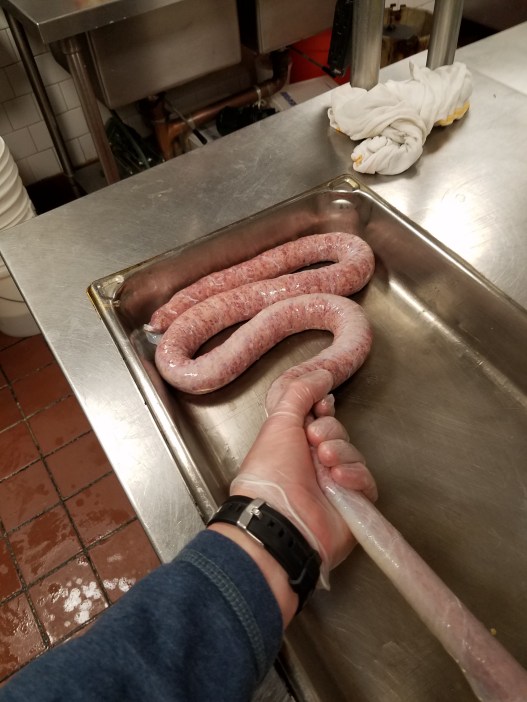
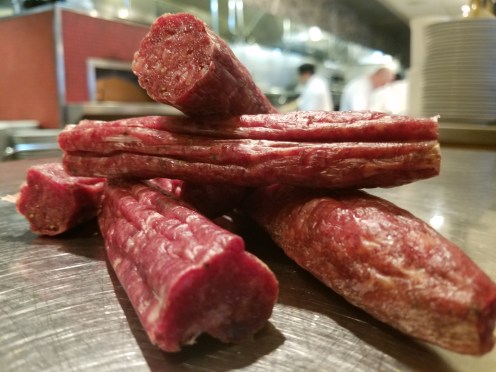
Making dry cured sausage is simple; grind some meat mix it with spices, stuff it into casings and hang it to dry in a fairly humid, cool space, then wait. To quote Tom Petty “the waiting is the hardest part”.  Three-ish weeks later, if all goes well you have a beautiful semi-dried full flavored, rich, fatty, dry, slightly tangy, cured sausage.  I have made this recipe many times with varied results, mostly great.  However, once in a while I have gotten a batch that just doesn’t work.  Don’t worry when it’s not right it’s obvious, it does not have the rosy meat color you expect from air-dried cured meat, it looks kinda gross and smells rotten.

Below is a pictorial of the steps we used to turn Hoosier’s fat and flesh into Saucisson Sec (dry-cured sausage).

Ground pork mixed with spices.

20170105_203617

The trusty hand cranked sausage stuffer, many hundreds of pounds of sausage have been made using this beast over the 15 plus years we have had it.

20170105_204233

I’m pushing out the sausage into casings.

20170105_204743

Sizing them up.

20170105_205131

Hanging them to dry in our curing room, next to some duck prosciutto that is just about done.

20170125_221246

Three weeks hanging and they’re done.

20170125_153454


Though we still have quite a bit of Hoosier left to use; most notably the head and a bunch of meat to braise, it may be a while before we get into it.  I will continue to write about as we utilize it.


Death of a Pig (part 1) Delivery

At EVOO all of the land-based protein we use is sourced locally, with the exception of beef, all are from whole animals.  We strive to purchase the best proteins with the least amount of environmental impact.  This will be the first in a series of posts revealing all of the planning and execution we do for nose-to-tail cooking and menu implementation of a pig.

The first thing we need to do is procure the hog.  We deal with several farms that raise pigs, some are growing less than 10 hogs a year which are ready when they are ready.  These farmers usually take orders in the early spring, as soon as they get the piglets, for a late fall delivery.  I recall a couple of years ago one of our annual pig suppliers Pete Lowy of Pete and Jen’s Backyard Birds in Concord MA held back delivery for a couple weeks because “the pigs are enjoying apples” which had recently fallen from the trees. He figured he would delay the inevitable so not only could the pigs uhm… pig-out, there would also be an added flavor benefit to the pork.  Pete and his wife Jen raise a handful of Mangalitsa pigs, a Hungarian breed known for their incredible fat.  We are one of the fortunate few to receive one of these beauties each year.

Other local farmers we use are producing top quality pastured hogs year round. At EVOO we purchase between 4 and 8 pigs a year.  As I hope you will see, over the length of these posts, there is a lot that goes into the complete utilization of each hog.  With the respect we have for the lives of these pigs and limited space in our kitchen, we need to use every bit of one pig before receiving the next.

The pig who you will be following through these posts is from our friends at Dogpatch Farm in Washington, ME.  His name, provided to us by Sue of Dogpatch is / was Hoosier.  Dogpatch Farm specializes in the Mulefoot hog which is a rare Heritage breed known for its freckled marbling, superb flavor and exceptional hams.

Hoosier

20160719_153242

My next post will take you through the first few hours after the pig comes through our doors.