Death of a pig (part 7) Ham

After two plus weeks in brine and 14 hours in the smoker Hoosier’s American Style Smoked Hams are done and they are beautiful; sweet, smoky, moist and tender.  We have been making this style of hams for many years, tweaking the recipe and methods to ensure a great ham every time.

Hoosier’s hams – each ham is cut into three pieces, brined, tied, smoked, chilled and sliced.

Smoking our own hams bring us much more than ham (the meat).  The meat could end up in ham sandwiches, part of a pasta dish, paired with cheese for a first course or even as a ham steak.  The skin makes a smoky gelatinous stock we often use in pigs skin risotto, soups and stews.  Scraps and bits are often used as a flavoring ingredient, such as in our Bangkok Chicken Wings where we pair the sweet ‘n’ smoky ham with Thai fish sauce, lime juice and spicy chilies.  We also always place a pan directly under the smoker to collect the drippings (liquid bacon), which finds its way into vinaigrette, sauces and marinades.

The fat that surrounds the ham, often 1 1/2″ to 2″ thick is freaking amazing.  Currently on our menu are Ham Fat-Potato Croquettes.  We take two parts diced ham fat and combine it with one part mashed potato, roll it into balls, bread ’em and then fry ’em. We’re serving them with mustard cream and last summer’s pickles.

A few of the dishes we are / have served using Hoosier’s hams-

Blue Corn Biscuits with Backroom Smoked Ham, Pete’s Sweet Pickles and Robinson Farm’s Swiss Cheese

20170118_180830

Bangkok Chicken Wings
20170123_174458
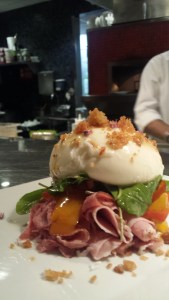
Sliced and served with local Burratina, arugula and Pete’s Pickled Peppers

20160601_204819

Ham Fat Croquettes

2013-02-01_19-51-14_741

The next post will be about Saucisson Sec, a dry cured sausage we made from Hoosier.

Death of a pig (part 6) Belly

A bit of a delay in getting this latest post out, I was visiting Cuba with my dad.  I will do a post about my trip in the near future.  Don’t worry we still have plenty of Hoosier to write about and serve.

Pig belly, oh glorious pig belly, a perfect marriage of meat and fat.  Cooked properly it has an unmatched succulence, melt in your mouth fat with just the right amount of meat.

At EVOO we have cooked pig bellies many different ways, usually braised, then glazed with a myriad of sweet and / or spicy sauces, sometimes fried and often finished on the grill.  Every so often we will cure and smoke the bellies to make bacon, though I get more satisfaction out of the other preparations.

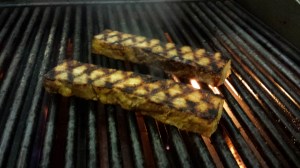
Hoosier’s belly on the grill

20141006_175714

Hoosier’s belly is being prepared this way: Sweet Soy Glazed Grilled Pig Belly with Miso Laced Parsnip Puree, Roasted Radishes and Carrot – Daikon Sprout Salad

20170104_183036

After braising the bellies we trim them to make evenly cut, nice looking, portion sized pieces.  With those trimmings we remove the skin and pulverize the crap out them making a semi-chunky paste, kind of like rillettes, only better.  We serve it at room temperature as a spread with homemade pickles.

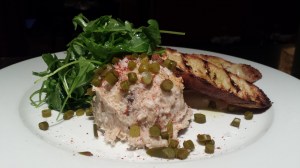
Pulverized Braised Pig Belly with Arugula, Pickled Garlic Scapes and Grilled Bread

20151124_190504

One of my favorite preparations: Gochujang Glazed Braised Pig Belly

20150501_193652

The Hams are just about ready, they will be the subject of the next post.

Death of a pig (part 5) Smoke

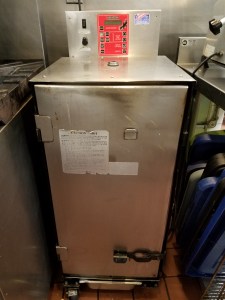
Smoke has been an integral part of our cooking since we opened in 1998.  At our original location we had an inexpensive charcoal / wood fueled smoker just outside of the restaurant’s back door.  We smoked all sorts of meat, fish and vegetables, we used the shit out of that smoker.  In our new (2010) location we didn’t have the option of putting a smoker out back, a city sidewalk was not going to work.  We needed to continue smoking food, it had become part of who we are.  After looking at many options and speaking with equipment specialists we went with an electric heat controlled floor model that the specialist insisted was big enough.

We quickly realized the smoker was too small and that the the initial heat is way too high. I think it’s programmed so that we to get the smoke going quickly.  The electric heat regulation is convenient, we just add smoke using wood chips and chunks; we have also smoked with different teas, coffee, dried herbs and spices.  I sometimes hope the smoker we have will shit-the-bed so we can get a bigger one.  Other times I think the smoker has been a work horse; most days it’s full of something, be it pig parts, pastrami, bluefish, salmon or veggies.

EVOO’s little smoker – filled with Hoosier’s bones.

20170106_20145820161222_131525

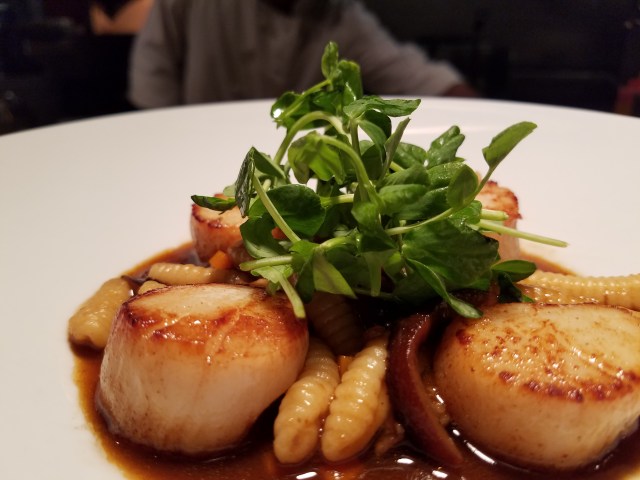
After a few days in brine the thinner pieces of pig are ready for smoking.  The skin is first, filling the smoker racks, adding a few chunks of hickory every hour or so, maintaining a temperature of just under 200 degrees for 6 to 8 hours.  We end up with some beautiful mahogany hued smoke bombs that we have used several ways in the past. We have often braised it and used it to flavor risotto, at times we have made a stew with the smoked skin and beans.  Hoosiers skin was braised, cut into strips and served with cavatelli and seared sea scallops.

Here is the finished dish Seared Sea Scallops with Cavatelli and Backroom Smoked Pig’s Skin20161217_202140
A video of Fredy our amazing prep cook making the cavatelli

We will progress through all of the bits that need smoking, three to four batches of skin.  A 200 lb pig has a lot of skin, this will take at least two days.  Then we will smoke bones another 1 – 2 days, after that the heart and a few pieces of tasso ham, followed by the head and eventually the American style hams. I will post about each of them as we work our way through this beautiful pig.

I think the next post will be about the belly, followed by more smoke and possibly saucisson sec.

Death of a pig (part 4) On the menu, pate

We received Hoosier from Dogpatch Farm on the previous day, working into the wee hours to get the pig prepared for future preparations.

On the second day our pig makes his debut on the menu, the chops are usually the first cut that make it.  Depending on the size of the pig, its pedigree and the thickness of the loin we get between 12 and 16 orders of  pig chops.  I typically serve them with one long meaty bone attached.  The time of year and our whim determine what we serve the chop with.

This is how we did up Hoosier’s chops.

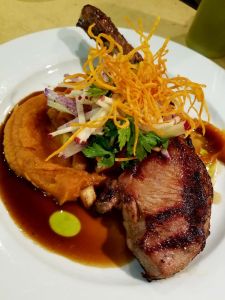
Grilled Sassafras Glazed Pig Chop with Bourbon Laced Sweet Potato Puree, Roasted Roots and Apple – Radish Salad.  Eva Sommaripa, one of our long time local farm partners, from South Dartmouth supplied us with the sassafras root for the glaze.  The sweet potatoes are from Red Fire Farm in Granby, MA and the roasted roots included parsnips, carrots and rutabaga are from Verrill Farm in Concord, MA.

Hoosier’s Chop

pig-chop

Within a couple of days of receiving the pig, the liver is quick to follow onto the menu, we almost always make pate.

I Hate Liver!  There are very few foods that make me cringe like liver, I can’t stand it!  It’s almost as gag worthy as when my mother cooks zucchini.  It’s bloody, mineraly, nasty flavor is a big turn off; I don’t even like the smell of it.  That said, it can have some positive attributes, I sometimes think of it like Thai fish sauce, in your face nasty by itself, but used in the proper way it can enhance and elevate the flavors around it, pate is a great example of this. Meaty, rich and boozy, a nice well made pate can be a real treat.  At EVOO we have been working on our recipe since we opened, over that time it’s gone from pretty darn good to exceptional.

We trim and weigh the liver to determine the amounts of the remaining ingredients.  Each pig usually provides us with enough liver to make between 6 and 8 pates.  We make the mixture and potion it into individual terrine size bags, freezing them and then baking them off as we need them.

EVOO’s Pate

The next post will be about smoke.

Death of a pig (part 3) brining and curing

Within hours of receiving Hoosier, he has been butchered and I will now start curing and brining the different parts.  This is often done after service starting around 11 pm usually finishing near 2 am, having consumed a couple of local drafts in the process.

One of my favorite local brews, anything by Night Shift.

The attributes of the pig and the needs of the restaurant will determine what I do with the pig.  If I already have a prosciutto hanging I will make American style hams; if I have a full stock of coppa, I can make tasso.  If the back fat is of top quality and we need lardo, I will make it.  Hoosier’s back fat is thick and beautiful, however, I have a Magnalitsa pig coming in soon and will use the back fat from that pig to make lardo.  Hoosier’s back fat will be diced, packed in 1 pound bags and frozen for future use in sausage making.

1 lb. bags of Hoosier’s back fat.

20161222_131643

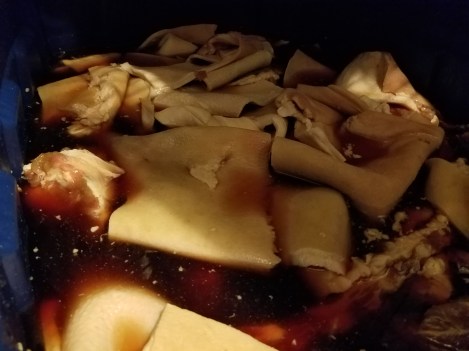
Enough already, here’s what I did with Hoosier: I brined the skin, most of the bones, the hams, feet and head in a salt – brown sugar brine.  I plan on smoking all of these items. The thickness and density of each item will determine how long they will remain in the brine, skin 3 days, hams 10 days plus.  As they are pulled from the brine they will be smoked.

Pig skin in brine.

20161221_130727

I trimmed and dry rubbed the shoulders for spiced coppa, I did the same with the jowls for guanciale.  I will keep these in the refrigerator for a few days, turning daily, until the cure fully penetrates the meat. I will then hang them in our drying room until they lose at least 30% of their initial weight, becoming meatily delicious in the process.

Guanciale, prosciutto and peppered coppa hanging in our aging room.

20141007_012426

In an effort to get some of the pig on the menu as quickly as possible I also give a quick mild brine to the pig chops, loin steaks and whole tenderloins.  These will brine overnight, before being sous vide, finished to order and put on our menu the following night.

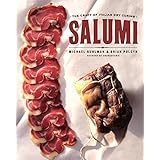
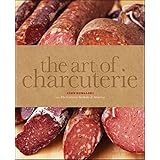
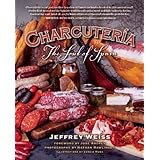
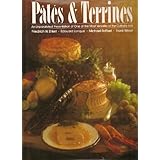
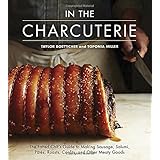
Some of my favorite charcuterie books that I have looked to for ideas and techniques.

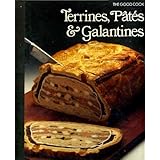
Product DetailsProduct DetailsProduct Details Product DetailsProduct DetailsProduct DetailsProduct DetailsProduct DetailsProduct DetailsProduct DetailsProduct DetailsProduct Details

I think my next post will be about Hoosier on the menu and possibly pate.

Death of a pig (part 2) Butchering

Within a few hours Hoosier’s 200 lb carcass needs to be broken down into more manageable sized pieces.  Having little formal training as a butcher, most of procedures that I follow are self taught. In culinary school butchering class was breaking down a chicken or two and a few demonstrations on fish butchery.  I clearly remember our meat fabrication instructor Mr. Perrillo saying “as long as you are cutting between meat and fat, chefy baby you’re on the right track”.  The school did serve some great meats at their highly acclaimed  restaurants, however, they hired professional butchers to fabricate for them.

Image result for culinary institute of america new yorkMy alma mater

I was fortunate, as a cook at The Bostonian Hotel in the late 80’s and early 90’s I had the opportunity to work with an accomplished butcher, Uriel Pinada.  He was very generous with his time.  With his guidance and my perseverance I was soon able break down smaller livestock , such as lamb, without screwing them up too badly.  Uriel is married to super chef Lydia Shire and still butchering; last I heard he is working at another Bostonian Hotel alum’s restaurant. I appreciate what he taught me, allowing me to gain the confidence I needed to handle much larger animals.

urielUriel Pinada

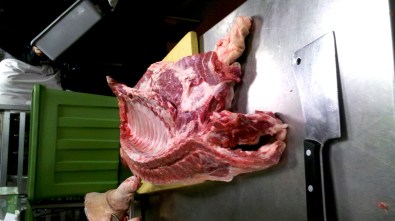
When a pig is delivered it is most often delivered split straight down the middle from nose to tail with a separate bag containing the liver, heart, tongue and kidneys.  I will write more about the innards later.  One half goes into the walk-in to stay cold, the other gets laid out on our back kitchen’s prep table.  I start right in, removing the bigger bits first to make the carcass more manageable, working my way through it until it is all processed. This usually takes several hours.  I am not going to get into the gory details, I will explain during subsequent posts were all of the parts we are using come from and how we process them.

genimage-9One side of the pig, in the process of being butchered.

I think of butchering whole animals as the necessary evil.  Though I have become quite proficient at it (see video below of me butchering a lamb), I really don’t like doing it.  I feel that if we are going to serve meat we need to do it the right way; support local farms with the least possible amount of environment impact.  I have often said “if meat didn’t taste so good, I would be a vegetarian”.  At least 3/4th of the meals I eat are vegetarian, most lunches and often dinner.  Note that while I am writing this my grill is getting smoking hot so I can cook some rare to medium-rare local beef burgers.

The next post will be about some of the curing that takes place before any of the pig finds it’s way onto our menu.

Below is a video of me butchering a lamb, you can see from my facial expressions that it is not one of my favorite jobs.


Death of a Pig (part 1) Delivery

At EVOO all of the land-based protein we use is sourced locally, with the exception of beef, all are from whole animals.  We strive to purchase the best proteins with the least amount of environmental impact.  This will be the first in a series of posts revealing all of the planning and execution we do for nose-to-tail cooking and menu implementation of a pig.

The first thing we need to do is procure the hog.  We deal with several farms that raise pigs, some are growing less than 10 hogs a year which are ready when they are ready.  These farmers usually take orders in the early spring, as soon as they get the piglets, for a late fall delivery.  I recall a couple of years ago one of our annual pig suppliers Pete Lowy of Pete and Jen’s Backyard Birds in Concord MA held back delivery for a couple weeks because “the pigs are enjoying apples” which had recently fallen from the trees. He figured he would delay the inevitable so not only could the pigs uhm… pig-out, there would also be an added flavor benefit to the pork.  Pete and his wife Jen raise a handful of Mangalitsa pigs, a Hungarian breed known for their incredible fat.  We are one of the fortunate few to receive one of these beauties each year.

Other local farmers we use are producing top quality pastured hogs year round. At EVOO we purchase between 4 and 8 pigs a year.  As I hope you will see, over the length of these posts, there is a lot that goes into the complete utilization of each hog.  With the respect we have for the lives of these pigs and limited space in our kitchen, we need to use every bit of one pig before receiving the next.

The pig who you will be following through these posts is from our friends at Dogpatch Farm in Washington, ME.  His name, provided to us by Sue of Dogpatch is / was Hoosier.  Dogpatch Farm specializes in the Mulefoot hog which is a rare Heritage breed known for its freckled marbling, superb flavor and exceptional hams.

Hoosier

20160719_153242

My next post will take you through the first few hours after the pig comes through our doors.

Why EVOO?

evoo's old sign

We have often been asked how and why we chose EVOO for the name of our restaurant.  This post shares with you some of the fun that took place towards the end of 1997 when Colleen and I were trying to figure out the name of our soon to open restaurant, not an easy decision, at least not for us.  You have to understand that Colleen and I aren’t the fastest when it comes to naming.  Both of our children’s names weren’t decided upon until  they were 3 days old and we filling out the exit papers at the maternity hospital.  Lot’s of deliberation was going on, for months, but, the final decision was not made until it had to be.

Many chefs use there names, which is great if your name is Jasper or Hammersley.  In my case using either Peter or McCarthy conjures up images of an Irish Pub, not a bad thing, just not what we had in mind for our restaurant.  Plus I don’t think I would have been comfortable naming the restaurant after myself.  The amount of shit that my friends and family would have given me would have been tremendous.  Of course there were many inappropriate eponyms that friends suggested.

Summer-shack-logohamersleys-bistro-boston-201201201810-1.hamersleys_logo

Using the address was another option.  118 Beacon Street, our original restaurant’s street address.  Beacon was seriously considered.  In the end using the address seamed a little to uptight for us, we wanted a fun name.

Toward the end our naming time frame, we had to get it done so we could incorporate, a necessary formality that usually takes place many months before a restaurant actually opens.   I was doing some consulting, helping some restaurants with menu design and recipes.  While writing a recipe for god knows what, instead of writing out extra virgin olive oil, I used the acronym EVOO,  not an original idea on my part.  I had been and had seen many of my peers use the same acronym for years.  Of course, this was all long before Rachel Ray’s claim to have originated the acronym.  It dawned on me that EVOO may be a good name candidate.  That night I suggested it to Colleen, she didn’t like it, which was not a surprise to me.  She often takes time to warm up to my ideas.  She thought that no one would know what it means, which they didn’t and many still don’t.

55578395rachaelray220200992320am

We actually had a list of potential names posted on our refrigerator.  We would cross off and add on as we went along.  For a long time EVOO was just another option, I really didn’t think that it would end up at the top of the list.  I wish I knew where that list was now, I think it would be fun to see the other names, I am curious what I would think of them now.  Were there any good alternatives amongst them?

If I remember correctly we had whittled the potential names down to two, EVOO and possibly Beacon.  During one of the many meetings we had with our lawyer, who was pressuring us to decide on the name (he needed it, so we could incorporate).  He asked us what names we were thinking of.  We told him, he immediately said “oh, you have to go with EVOO, it’s fun, it’s different, people would remember it” which were all things that we were looking for in a name.  That sealed it for us, EVOO went to and stayed at the top of the list.

The only reason that I have second guessed our choice is that the Food Network crowd who know what the acronym represents think that we are an Italian or Mediterranean restaurant. Which we are not.  Describing  the style of food we serve and why is the topic for a future post, it’s not a simple answer.

I just had Colleen proof this post to be sure it was factually correct.  She agreed with everything except for my suggesting EVOO.  Her delusional memory recollects that she saw it on some notes that I was writing for the  previously mentioned consulting job.  Claiming she suggested it to me.  Once again someone taking credit for my idea. Women…

evoo logo

Thanksgiving

I love Thanksgiving! A true family holiday, no gifts, no forced professions of love, no candy for over stimulated kids, just good food, friends and family.

16 years ago when we opened EVOO Colleen and I thought it would be great to have family Thanksgiving dinner at the restaurant.  Having enough space to gather both of our familys and friends together would no longer be a problem.  Back then dinner at my house was not really an option, 800 square feet, a closet sized kitchen and only one bathroom would have made it very difficult for more than just a few people getting together.  Colleen and I both have large familys that get along quite well and we thought it would be great fun to get everyone together without worrying about space.  So a tradition was born.

Every year my parents arrive from Florida, my sister from Saratoga, brother from Maine, most years another brother shows up from Madrid with at least part of his family.  Some years my other sister even shows up from St Augustine, Florida.  Colleen’s family is not as scattered as mine, most of them are still in eastern Massachusetts.  With the exception of a brother who lives in Moultonborough, NH.  To that we add our extended family, aunts, uncles, cousins, nieces, nephews and their family’s.  That’s not it, add to that friends, people we work with who either do not have local family or are not close to them.  We end up with a real rocking family party, with infants,  kids, teenagers, young adults, us middle agers and elders.

20131128_134007

Me with my sister Kathleen and Brother Dennis, Dennis is sporting the purple and orange Gobble Gobble Gobble shirt from the road race that we ran earlier in the day.

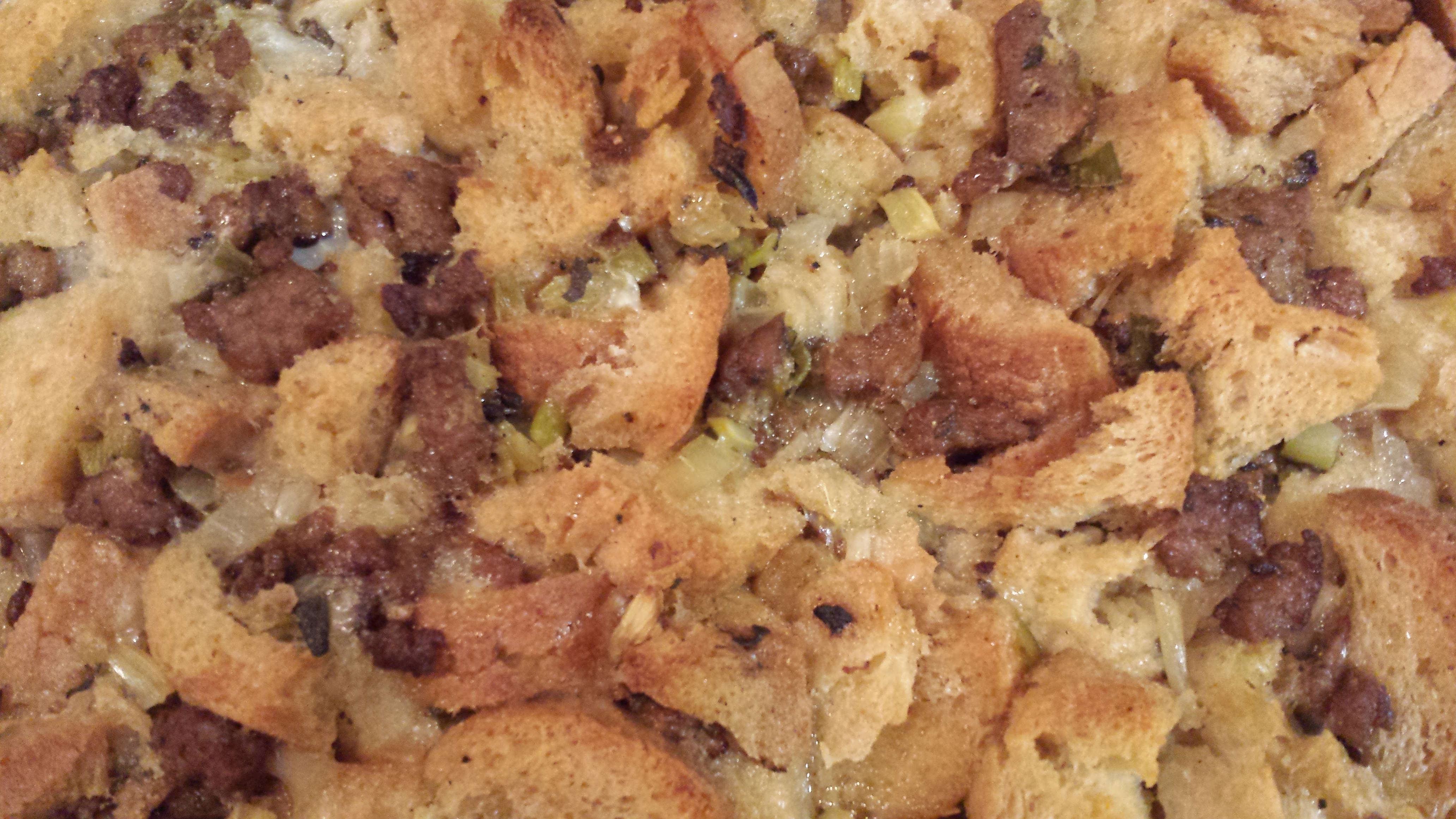
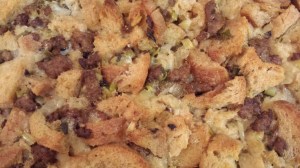
I obviously cook the main course, a very traditional roast turkey with all the fixings.  Others bring first courses, cheese and desserts.  I order 4 each 25 pound organic turkeys from a farm in southern Vermont.  The days prior to Thanksgiving I prep most of the vegetables, make turkey stock, prep the stuffing.  I always make 2 kinds of stuffing, one is referred to as Harrington Stuffing, plain and boring.  The other changes each year and will be full flavored and interesting.  This year’s was packed  with spiced pork sausage and leeks.
20131127_200415

a close-up of the delicious real stuffing.

On Thanksgiving morning there is usually a group of us that run Somerville’s  Gobble Gobble Gobble 4 mile road race.  This year we were surrounded by slackers, only my brother Dennis and I ran the race.  After the race with some combination of mine and Colleen’s brothers and brother-in-law, some of which are professional cooks, show up to do the final cooking.  Roasting the birds, finishing up the vegetables and making gravy.  By the time we are slicing the turkey, beer and wine are pouring freely.
20131128_134353

Dennis and I pulling together the last of the dinner prep.

20131128_153150

The main course, one of 4 turkeys that were cooked.

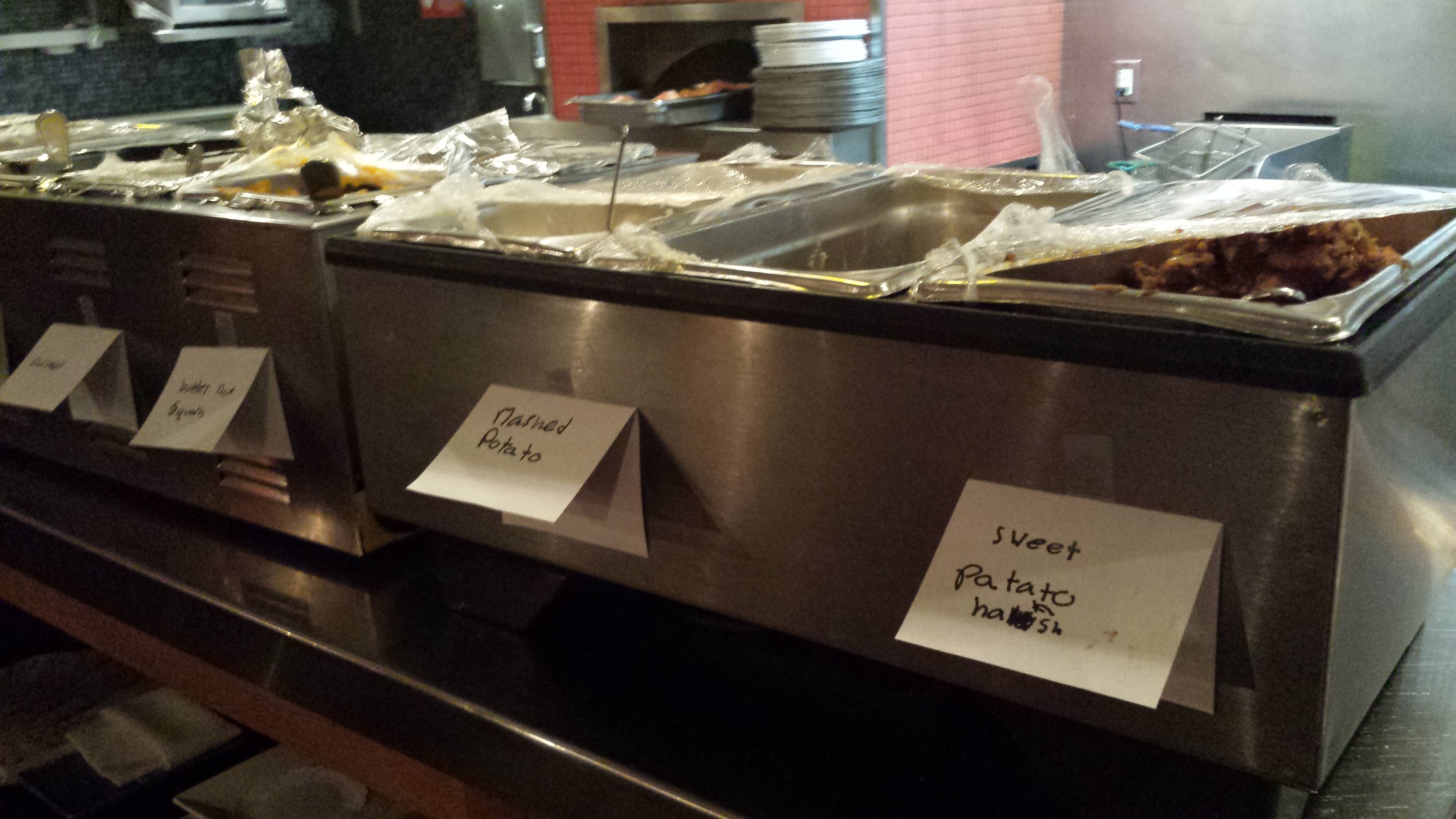
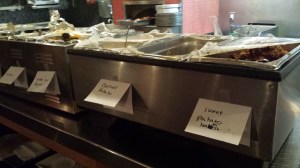
We set up a big buffet line and let people have at it (tradition is my mother-in-law, Marilyn Harrington is first in line), replenishing as needed.  For the most part everyone shares in the clean-up.  Kids enjoy pouring soda and bussing tables.  The past few years I have scheduled (paid volunteers) 2 dishwashers to help with the cleaning.  I insist that they join us at the table for dinner.  They get to see how this large dysfunctional American family celebrates it’s uniquely American holiday.
20131128_163909

The buffet line showing off 8 year old Shane’s hand written labels.

20131128_203535

5 year old Cate showing off her bartending skills.

Inevitably dinner is finished, each year the same group of us ends up watching, with limited interest (unless the Patriots are playing)football.  Friends who had dinner with there own family’s will often stop by for a night cap.

20131128_163745

Cate and Julia doing what girls do best, talking.

My 16 year old nephew Zach McCarthy recorded and produced the this time-lapse film documenting our day.

20131129_234933

Zach McCarthy
Vegetarian Dishes

First I want to point out that I am not a vegetarian.  Second, I do agree that there are healthful benefits of eating a vegetarian diet. Third, it pisses me off when I dine out at a nice restaurant and they either don’t offer vegetarian dishes or put the obligatory vegetarian pasta or risotto dish on the menu.

Lunch for me is almost always meat free.  Having pizza, sushi, ramen, a sandwich or a burrito is never a problem, that style of restaurant usually offers several vegetarian options that are flavorful and satisfying.  The bitch is at sit down restaurants the vegetarian option is often an after thought; just some lame-ass dish to check off the box.

At EVOO I strive to have interesting vegetarian dishes on the menu.  When coming up with a dish that is not based on animal protein I think whether adding an animal product to the dish would make it better or not.  A great example of this is soup.  If you read recipes in books, magazines or online, the recipes usually calls for chicken stock.  Why? I have no idea.  If you are making a carrot soup why would you want it to taste like chicken, or mushroom soup tasting of beef.  Sure you can make a delicious soup using meat stocks. But, you can also make the same soup just as good, possibly better using vegetable stock.  If you are making corn chowder, make a corn stock, mushroom soup use mushroom stock, after all these are the flavors that you are trying to showcase.

Here are some of our recent vegetarian dishes:

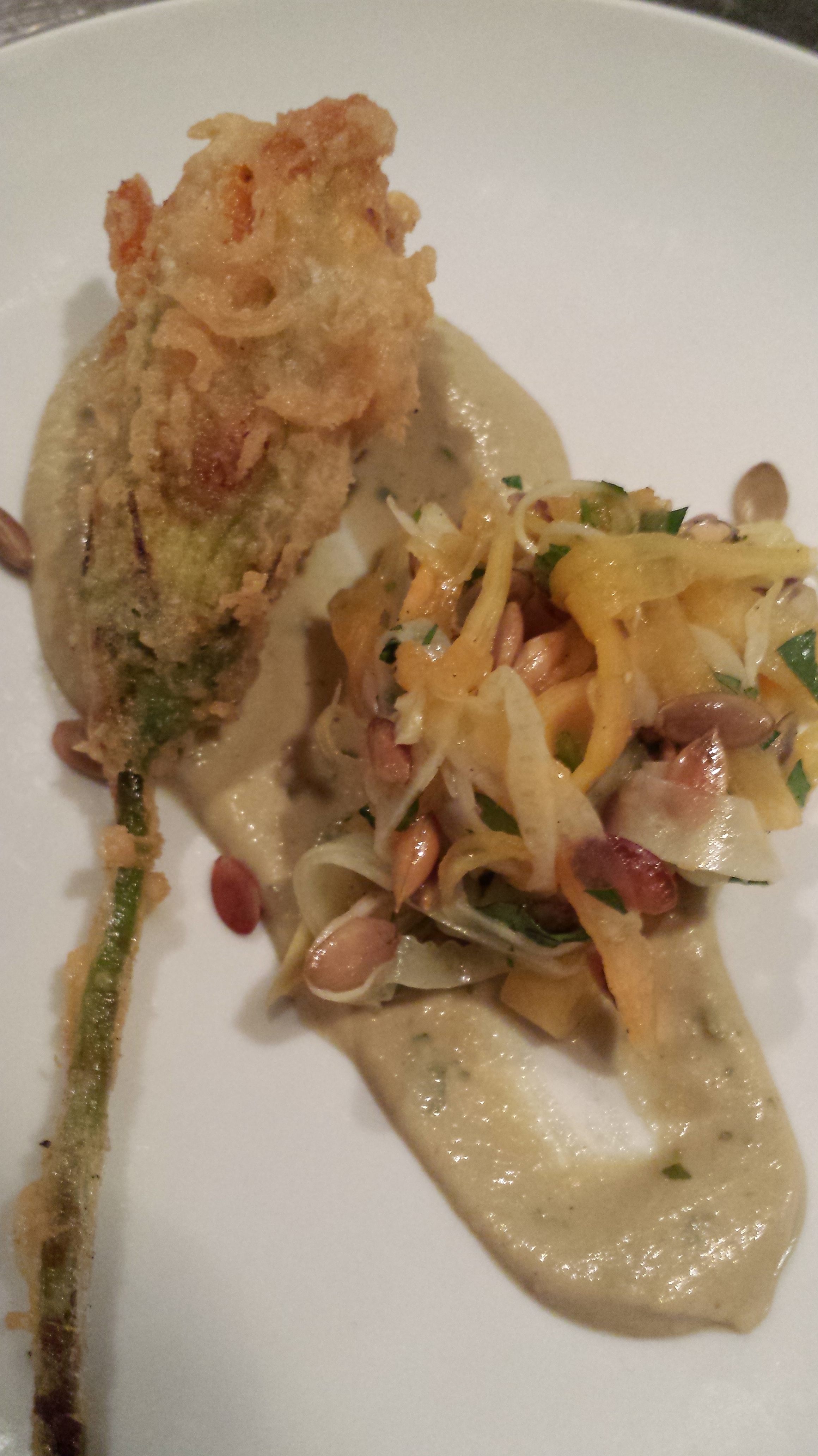
Pumpkin-Smoked Goat Cheese Stuffed Fried Squash Blossom.

20130921_211058

Miso Braised Eggplant with Sesame Mashed Potatoes, Apple-Seaweed Salad and Gingered Plum Sauce.

20130923_190343 (1)

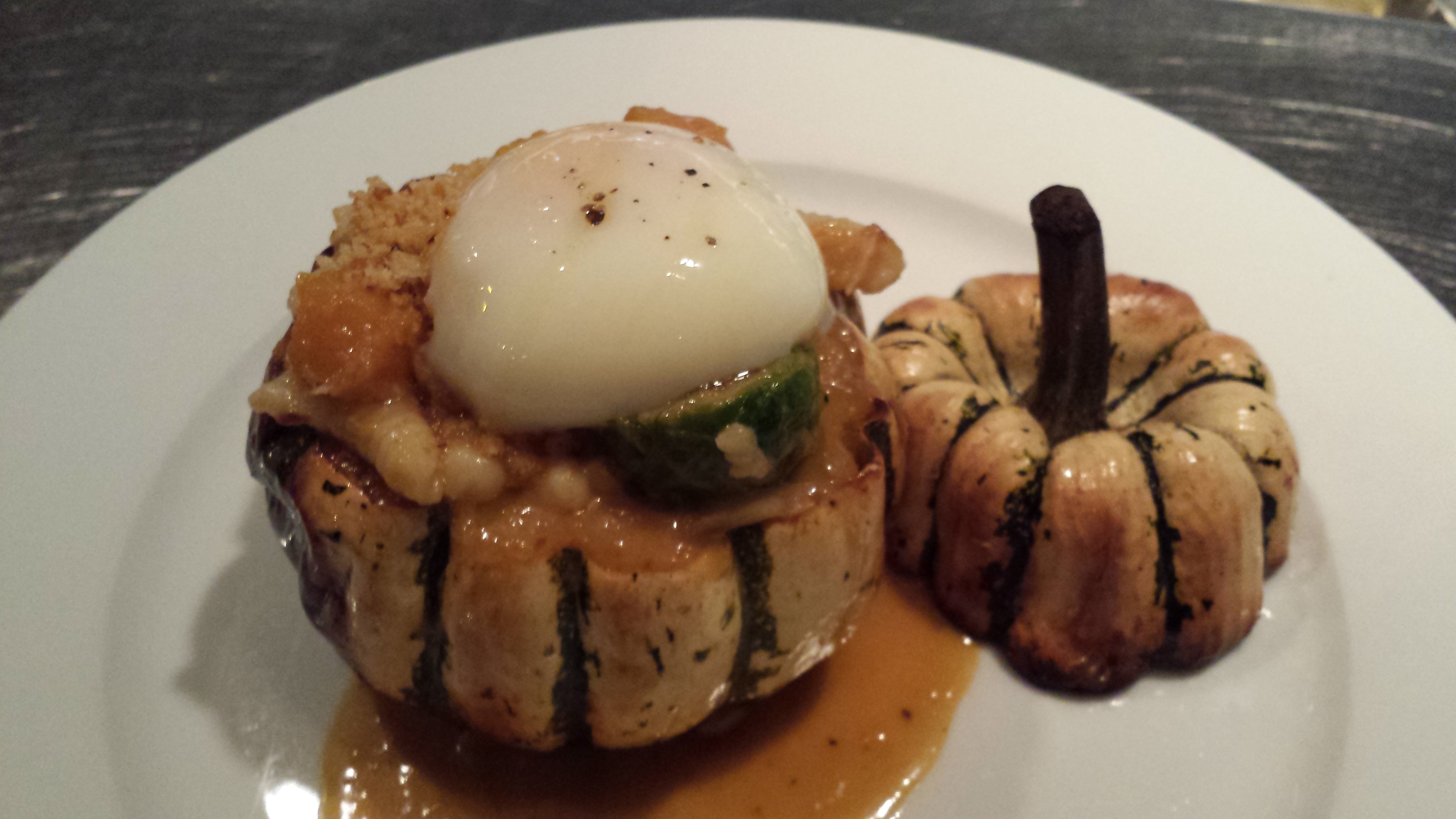
Baked Sweet Dumpling Squash Filled with Ricotta Cavatelli, Hen-of-the-Woods Mushrooms and Brussels Sprouts.

20131022_205913

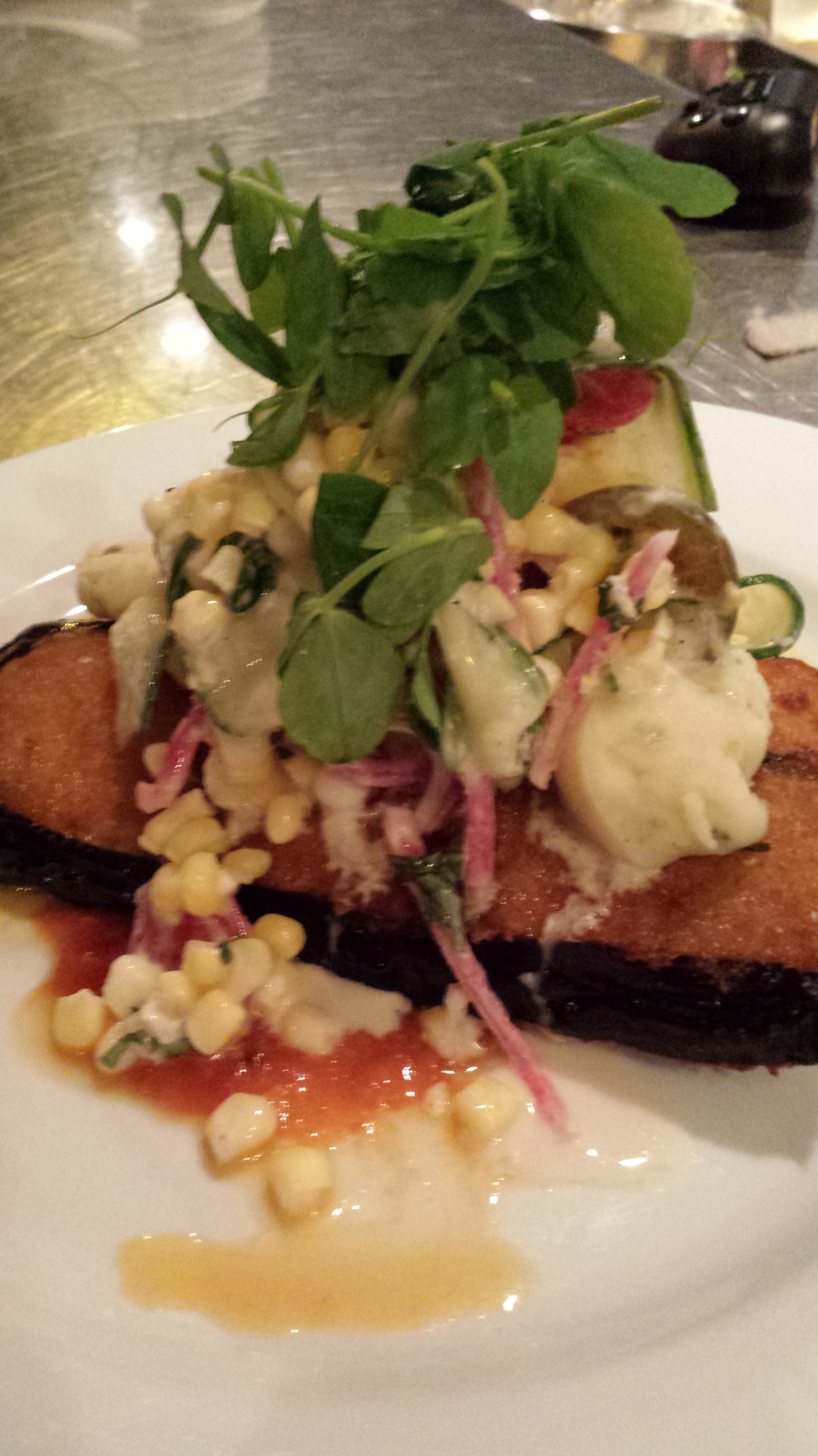
Crisp Fried Eggplant with Curried Tomato Sauce and Yogurt Dressed Cucumber Salad.

20130828_205855

Eat your veggies!!